

Key takeaways
Online payments are now a client expectation, making digital billing essential for law firms that want to offer a smooth, modern payment experience.
Legal-focused payment processors provide critical compliance tools, including trust-account safeguards and IOLTA-friendly workflows.
Electronic payments speed up collections and reduce administrative work, helping firms improve cash flow and minimize manual billing tasks.
Selecting the right payment system depends on a firm’s needs, including security standards, integrations, payment flexibility, and support for legal-specific accounting rules.
Getting paid promptly is essential to any firm’s financial health, but it’s a challenge that continues to frustrate many attorneys. According to the 2025 Legal Industry Report, 68% of legal professionals say collecting payment from clients is one of their firm’s biggest hurdles.
As client expectations evolve, it’s no longer enough to rely on paper checks or clunky third-party systems. Clients expect secure, convenient ways to accept payments online—law firms need solutions that align with professional standards and support the financial realities of running a modern legal practice.
In this guide, we’ll take a close look at eight of the best legal online payment processors attorneys are using in 2026. Whether you’re looking to speed up receivables, improve the client experience, or ensure compliance with trust accounting rules, the right solution can make all the difference.
What is an online payment system?
An online payment system allows businesses to accept and process electronic payments from clients through digital channels. These systems securely move funds from a client’s bank account or credit card to a business account using encrypted technology and standardized financial networks.
For law firms, this typically means giving clients the option to pay invoices through a secure online portal, rather than by mailing checks or paying in person. A legal payment solution may also offer features like automated invoice creation, scheduled payments, and compliance tools for trust accounting. These systems reduce administrative overhead while making it easier for clients to pay on time.
An online payment system for lawyers is the bridge between your firm and your revenue—streamlining the exchange of funds so you can focus more time on serving clients.
Top 8 legal online payment systems for law firms
Finding the right payment solution can change how your firm handles billing, collections, and client relations. Below are eight recommended systems used by legal practitioners.
1. 8am™ LawPay
8am LawPay is an online payment solution built for the specific needs of law firms. Unlike general-purpose processors, it’s designed to support compliance with legal billing standards, including Interest on Lawyers’ Trust Accounts (IOLTA) guidelines and PCI Level 1 requirements. The solution helps firms maintain proper trust accounting practices by automatically separating client funds from operating funds—reducing the risk of errors and keeping financial records audit-ready.
LawPay is used by more than 60,000 firms across the U.S. and Canada and is approved by all 50 state bars, the ABA, and dozens of local and specialty bars. In addition to its compliance focus, LawPay also gives firms tools to improve cash flow, reduce manual work, and make the payment process easier for clients.
Key features
Next-day deposits: Access funds faster and maintain a steady cash flow
Automated invoice creation: Minimize manual billing tasks by generating invoices automatically
Pay Later fee financing: Give clients flexible payment options and get paid up front
2. QuickBooks Payments
QuickBooks Payments is an online payment processing tool that integrates directly with QuickBooks Online. It’s commonly used by small businesses across industries and offers features like invoice customization, recurring billing, and basic payment scheduling. For law firms already using QuickBooks for accounting, it can be a convenient option for managing payments within the same system.
However, QuickBooks Payments is not tailored to the legal profession and does not include tools for IOLTA compliance or trust account management. Firms that need to handle client funds in accordance with bar regulations may need to look for additional solutions or workarounds to stay compliant.
Key features
PCI compliance: Maintain secure processing standards to protect client payment data
Customizable invoices: Create and send branded invoices directly within QuickBooks
Scheduled payment plans: Automate recurring or installment payments to improve billing consistency
3. Tabs3
Tabs3 is a longstanding legal billing and practice management system that gives firms the option to choose between cloud-based or on-premise deployment. Known for its dependable performance and familiar interface, it offers a traditional desktop-style experience supported by updated financial tools. The software includes built-in time tracking, expense logging, and customizable billing templates, making it a practical choice for solo attorneys and midsize firms alike.
Key features
Cloud and on-site subscriptions: Firms can choose the deployment model that best matches their IT preferences
Surcharging: Allows firms to pass along credit card fees to clients ($50 monthly fee applies)
Pay Later: Offers clients a fee financing option through PayPal, giving them the option to pay over time
4. Stripe
Stripe is a widely used payments solution that caters to businesses of all sizes, including law firms. It offers a broad global reach and powerful customization through its developer-friendly tools. While it wasn’t built specifically for legal billing or trust accounting, many firms choose Stripe when they need flexible payment workflows, bespoke branding, or the ability to embed payments into websites and mobile apps.
Key features
Instant payments: Receive funds faster by enabling expedited transfers (additional fees apply)
Custom payment pages: Build and embed branded payment flows
Priority customer support: Access enhanced support options for an added cost when more hands-on help is needed
5. Square
Square is a popular payment processor best known for its in-person checkout hardware and retail-friendly point-of-sale (POS) tools. Many small businesses rely on Square for quick countertop payments, mobile card readers, and simple tap-to-pay transactions. While law firms can use Square to accept online payments, the system is primarily optimized for storefronts, food service, and point-of-sale environments—so some of its most well-developed technology is focused on those use cases rather than legal billing or trust account needs.
Key features
POS equipment: Square invests heavily in point-of-sale equipment; however, it is geared toward retail environments
Buy Now, Pay Later: Clients can pay over time using Cash App Afterpay
Loyalty programs: Firms can create rewards programs or incentives to encourage repeat engagement
6. Headnote
Headnote is a legal payment platform that focuses on streamlining the payment process while maintaining a professional experience for clients. The solution offers standard online payment tools—such as invoice links and credit card acceptance—along with a few client-facing features that help firms gather feedback and manage disputes. Unlike some processors that offer in-person options, Headnote is designed specifically for online use, which may suit firms that operate virtually or don’t require physical payment hardware.
While its legal-specific positioning appeals to some small firms, Headnote doesn’t support features like tap-to-pay, QR code payments, or in-person terminals. However, it does include tools to support smooth online transactions and reduce follow-up work for attorneys.
Key features
Client satisfaction surveys: Automatically prompt clients for feedback during the payment process
Chargeback assistance: Helps firms respond to and manage disputed transactions
Online payments only: Does not support in-person transactions or hardware-based payments
7. LeanLaw
LeanLaw is a legal billing solution built with a focus on time tracking, expense management, and financial reporting for law firms. It’s often used by smaller practices looking for a lightweight billing platform that integrates directly with QuickBooks Online. The software emphasizes visibility into firm performance, with tools that allow attorneys to track revenue, monitor billable hours, and review collections data over time.
Key features
Same-day payments: Available for an added 1% fee to access funds faster when needed
Performance reporting: Includes billing analytics and revenue tracking over time
QuickBooks Online integration: Syncs billing data directly with QuickBooks for accounting consistency
8. Clio Payments
Clio Payments is the billing and payment processing tool integrated within Clio Manage, a cloud-based legal practice management system. It’s available only to firms already using Clio, and is not offered as a standalone solution. For existing Clio users, the integration can handle payments, billing, and basic financial tracking within a single system.
While Clio Payments includes standard features like online payment acceptance and invoice generation, it offers less flexibility than some alternatives—particularly for firms that need more robust time tracking or want standalone payment tools.
Key features
Built-in integration: Available only within Clio Manage, with no standalone payment option
Surcharging support: Recently introduced in states where permitted by law
Basic time tracking: Includes a single timer to track billable hours (a more limited feature compared to solutions that allow multiple timers to run simultaneously)
Types of electronic payments most used by attorneys
As the popularity of electronic payments has grown, so too has the number of methods for how lawyers get paid.
Two of the most popular types of electronic payment, debit cards and credit cards, will already be familiar to you.
Another option is virtual cards, which are electronic tokens that are only valid for a single use and a predetermined amount. Virtual cards are typically emailed to a vendor and treated like credit cards.
It’s also worth being familiar with ‘Automated Clearing House,’ or ACH payments. Most ‘direct’ forms of paying online, i.e., through direct deposit or electronic checks, are ACH payments.
What are the benefits of legal online payment processors?
Offering digital payment options isn’t just about convenience—it’s a strategic move that can help law firms improve client relationships, boost revenue, and operate more efficiently. When you choose a payment processor built for legal use, you gain access to tools that support trust compliance, speed up collections, and reduce the amount of time your staff spends on manual billing tasks.
Below are some of the core benefits firms can expect when using a legal-focused online payment solution.
1. A better client experience
Clients expect professional, flexible payment options—especially when they’re managing legal expenses alongside other financial obligations. Giving clients a secure, convenient way to pay online removes barriers and avoids awkward conversations about overdue balances. It also makes your firm easier to work with.
Many legal payment processors allow firms to offer features like scheduled payments, digital invoices, and financing options such as Pay Later. These tools enable clients to pay on their own terms, reinforcing trust and transparency throughout the relationship.
2. More client prospects
Flexible payment options can be a deciding factor for prospective clients. When people are comparing firms, the ability to pay online, set up a payment plan, or finance their legal fees may influence who they choose to work with.
Online payment tools can also reduce friction during the intake process. Features like payment links and digital invoicing make it easier to complete onboarding quickly and move qualified leads into active cases.
3. Faster payments
Electronic payments are beneficial from a business standpoint because they help attorneys save time and effort when running a law firm.
First, electronic payments translate into faster payments. Based on the LawPay and MyCase 2024 Legal Industry Report, current customers accepting electronic payments through LawPay collected 33% more from clients, and legal bills were paid nearly four times faster compared to those paying by cash or check. You can even receive payment in as little as one business day with solutions such as Next Day Payments from LawPay.
Electronic payment solutions also make it possible for lawyers to easily see whether a client has paid their bill, and to send automated or manual reminders. Finally, e-payments eliminate the risk of invoices or checks getting lost in the mail. This all means you’ll leave much less money on the table.
4. Optimized workflows
Because online payment solutions allow for automated invoicing or recurring law firm payments, electronic payments prove incredibly useful when you have client work on retainer or over repeated transactions.
Many electronic payment solutions on the market also offer integrations with other software solutions that lawyers may use for their practice, such as case or practice management software, timekeeping software, and accounting/bookkeeping software. This prevents law firm managers from having to jump between multiple tools or reconcile data from different programs.
5. Increased data security
Online payment systems for law firms can reduce the risks associated with handling sensitive financial information. When your firm uses a secure, cloud-based payment processor, there’s no need to store client credit card numbers or bank account details on your own servers.
Many established legal payment solutions utilize encryption and adhere to PCI Level 1 compliance standards to safeguard financial data and ensure the security of every transaction. This reduces the chance of a breach and gives clients added confidence that their information is being handled responsibly.
Key online payment processing features attorneys should look for
Not all online payment systems are built for the legal profession. To protect your firm and your clients, it’s important to choose a solution with features that support compliance, efficiency, and transparency.
Here are six essential capabilities to look for:
Trust account compliance: Legal payment processors should support IOLTA and other trust accounting rules by preventing commingling and maintaining accurate records of all client fund activity.
Separate operating and client funds: A system that automatically separates earned and unearned funds reduces the risk of trust account violations and keeps your firm audit-ready.
Transparent transaction reporting: Detailed, easy-to-access reports help your team monitor payments, track revenue, and reconcile accounts without guesswork or manual calculations.
Integration with legal practice management tools: A processor that works with your firm’s case management software can streamline billing, reduce duplicate data entry, and keep payment records in sync with client files.
Ability to provide lawyer payment plans: Flexible billing options, such as payment plans or Pay Later financing, make it easier for clients to manage costs and can improve your collection rate.
Security & encryption standards: Look for systems that meet PCI Level 1 compliance and use encryption to protect sensitive data—keeping every transaction secure and reducing your firm’s liability.
How to ensure law firm payment processing compliance
Law firms are held to strict financial rules, especially when handling client funds. Choosing an online payment solution that supports compliance from the start can help your firm avoid serious ethical violations and accounting errors. Below are two key areas where your payment processor should offer built-in safeguards.
Comply with IOLTA guidelines
To stay compliant with IOLTA requirements, firms must ensure that client funds are never commingled with operating funds. This includes unearned retainers, settlement funds, and other monies held in trust on a client’s behalf.
The right legal payment processor will help your firm maintain compliance by automatically separating trust and operating funds, preventing chargebacks from being withdrawn from a trust account, and maintaining clear records of every transaction.
Properly manage payment processing fees
Credit card or electronic payment processing fees are a standard part of accepting online payments, and many firms choose to treat them as a routine business expense. For practices looking to reduce processing fee costs, some legal payment processors offer the option to add a surcharge to credit card payments, helping offset a portion of those fees. This can be a useful tool for attorneys looking to maintain healthy margins while offering clients flexible payment options. Be sure to review your state’s laws and bar rules and restrictions around surcharging to evaluate your options.
Scale your law firm with LawPay payments
Offering secure, modern payment options is one of the simplest ways to strengthen your firm’s financial operations and improve the client experience. LawPay provides legal-specific billing and payment tools that help firms reduce administrative work, expedite payments, and stay compliant with trust accounting requirements.
Here are some key LawPay tools that support firm growth and financial control:
Next-day payments: Access funds just one business day after a client makes a payment—faster than standard settlement timelines offered by most processors.
Online payment options: Accept credit cards, debit cards, and electronic check (eCheck) payments to give clients more flexibility and reduce delays.
Scheduled payments: Let clients schedule future payments or set up recurring billing, minimizing follow-up and improving cash flow predictability.
Pay Later: Give clients access to legal fee financing while your firm receives 100% of the payment up front.
Card Vault: Securely store client payment methods for faster, more convenient future billing.
If you’re ready to see how LawPay can benefit your firm firsthand, schedule a LawPay demo. Or, if you’re ready to get started now, sign up for LawPay today.
Schedule a demo to see what LawPay can offer your firm.
Get a demo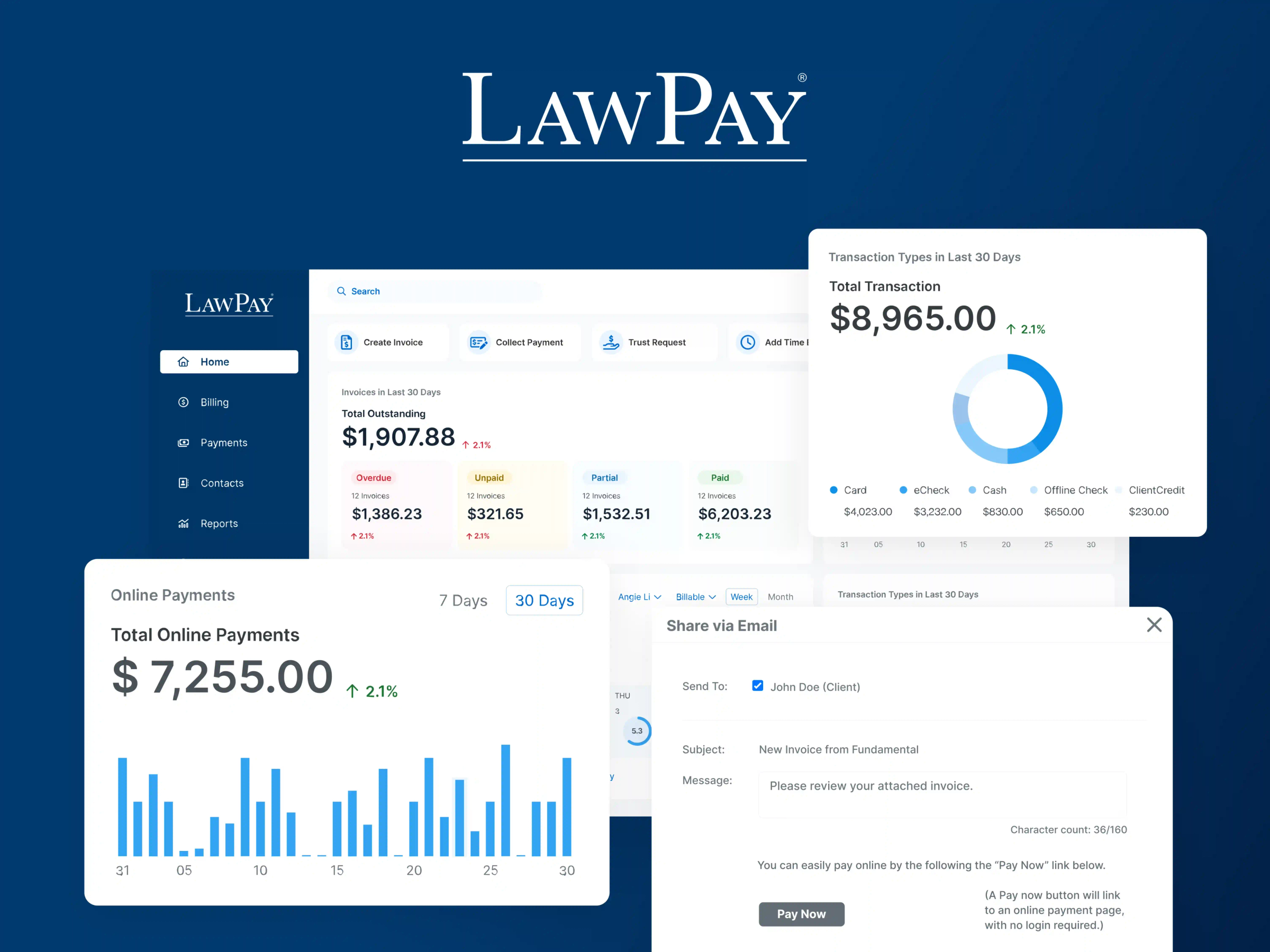
About the author

Rob Heidrick is a Senior Content Strategist for 8am, a leading professional business solution. He covers the latest advancements in legal technology, financial wellness for law firms, and key industry trends.