

Key takeaways
-
Legal fee financing lets firms get paid in full upfront while allowing clients to pay fees in installments over time.
-
Offering financing helps attorneys bring in new business and save time on collections and follow-ups.
-
Software-based financing options connect directly to firm billing systems, support trust accounting, and simplify reconciliation.
-
Firms should compare financing options based on credit limits, lender options, and how well each solution integrates with existing billing systems.
What if you could receive your total fee upfront at the beginning of an engagement while still allowing your clients to pay in installments? With legal fee financing, it’s possible—and many firms are already using it to remove financial barriers that once limited bringing in new business.
Client expectations are also shifting. Today, clients are accustomed to paying for large expenses in manageable installments, with clear terms and minimal friction. To keep pace, law firms need billing systems that support flexible payment options without adding complexity. Offering legal fee financing can help your practice reach more clients, keep matters moving forward, and improve revenue consistency.
Fee financing can also benefit your clients. With the ability to spread out costs over time, legal help becomes more attainable, and clients have more visibility into what they owe and how long repayment will take.
In this article, we’ll examine the best legal fee financing software for attorneys in 2026, with a focus on solutions that combine payments, billing, and practice management in one platform. We’ll also cover how these tools compare to traditional payment plans and what to look for when choosing the best solution for your firm.
What is legal fee financing?
Legal fee financing is a legal fee installment loan option that allows clients to pay for your services over time rather than in a single upfront payment. Instead of putting the full balance on a credit card, clients repay the cost of a lawyer in scheduled installments, often with clearer terms and, in some cases, lower interest rates than traditional credit cards, depending on the client’s credit profile.
For law firms, legal financing is one of several flexible payment methods that can be offered through software-based payment and billing platforms. These tools connect financing directly to invoicing and collections, so firms can extend payment options without taking on the administrative work of managing loans themselves.
It is also helpful to distinguish between client-side loans and firm-enabled financing.
-
Client-side loans are arranged independently by the client through a bank or consumer lender and are not included in the firm’s billing process.
-
Firm-enabled financing is offered at the point of payment through legal software and is designed to align with legal ethics rules, trust accounting, and standard invoicing workflows.
By reducing the pressure of a single, high upfront bill, attorneys can make their services easier for clients to access, who may otherwise delay or forgo legal help.
Here are examples of the types of legal fees clients commonly pay using legal fee financing:
-
Attorney’s hourly fees
-
Flat fees
-
Contingency fees
-
Retainer fees
-
Statutory fees
Aside from the attorney’s fees, there may be additional expenses depending on the type of case you are taking on. These fees may include court fees, travel expenses, expert witness fees, or investigator fees.
Top 5 legal fee financing solutions for law firms
Legal fee financing is typically offered through legal payments software and practice management platforms that also have tools for invoicing, trust accounting, and client billing. The solutions below vary in scope and functionality, but they each allow firms to accept financed payments without having to build new workflows from scratch.
1. 8am™ LawPay and 8am MyCase
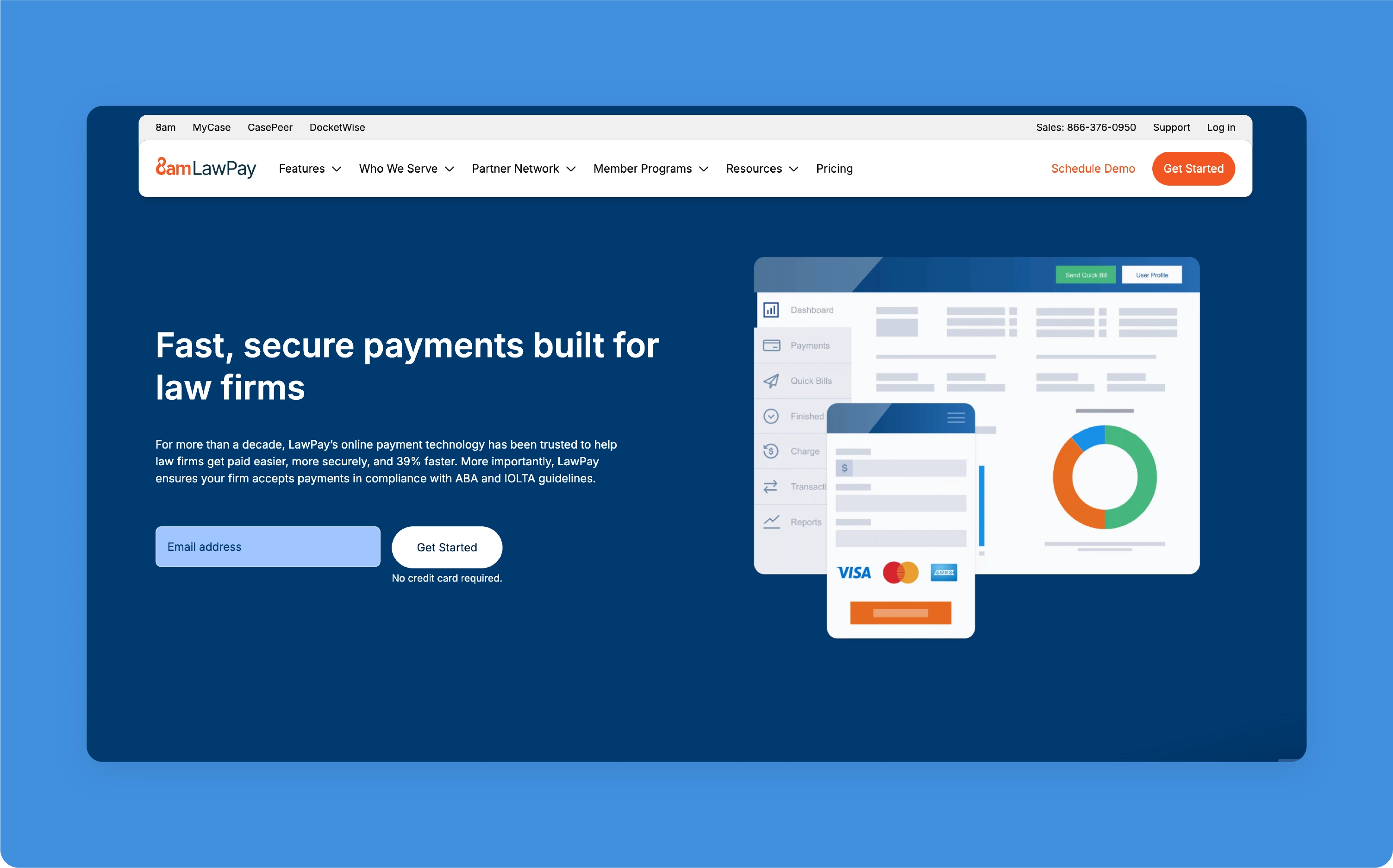
Pay Later is available to firms that process payments through LawPay, including those that also use MyCase for practice management. Clients can apply for Pay Later through your firm’s payment page and receive a real-time decision from the lender, Affirm. After the loan is approved, your firm receives payment in full within the same system you use to send invoices, accept payments, and manage client accounts.
Strengths:
-
Wide range of repayment terms (3 to 24 months)
-
Support for transactions up to $30,000, with no late fees
-
Integration with your firm’s billing and IOLTA-compliant trust accounting workflows in LawPay
Weaknesses:
-
Financing is available only through Affirm; firms do not have access to additional providers such as PayPal or Klarna.
2. Tabs3
Tabs3 is a long-standing legal practice management and billing software suite that helps attorneys handle everything from time tracking and billing to trust accounting and matter organization. Through its Tabs3Pay integration, firms can offer online payments and financing directly from client invoices.
Strengths:
-
Tabs3 offers financing and payment processing through PayPal, a widely recognized brand that many clients already trust.
-
Connects PayPal financing to Tabs3’s billing system, keeping financed payments tied to specific invoices and matters.
Weaknesses:
-
Tabs3 financing is commonly capped at around $10,000 in credit, which is significantly lower than the top published options from several other vendors, including LawPay.
-
Rates tend to be higher than competitive alternatives, which may increase the cost of financing for clients.
3. LEAP
LEAP is a cloud-based legal practice management platform with tools for case management, billing, trust accounting, document automation, and online payments. Financing is offered within LEAP’s standard billing and payment workflow, offering multiple lender options rather than relying on a single financing provider.
Strengths:
-
LEAP now offers legal fee financing through both Affirm and Klarna, providing clients with multiple lender options and giving firms flexibility in the types of plans they can present.
-
The platform’s broad set of integrated tools—including matter management, billing, trust accounting, and document automation—helps keep all client financial and case information in one system, making it easier to track financed invoices alongside other firm workflows.
Weaknesses:
-
The platform’s complexity and manual workflows may feel cumbersome for firms seeking a more streamlined way to offer fee financing.
-
The company does not publicly disclose interest rates or credit limits, which can make direct comparison difficult for firms evaluating fee financing tools.

4. Clio
Clio is a widely used legal practice management platform that handles billing, time tracking, and online payments. Its fee financing option, introduced in late 2025, is built into Clio’s existing payments experience, allowing firms to present clients with installment-based payment choices within the same system they already use for invoicing and collections.
Strengths:
-
Well-known platform with a large installed user base across a range of practice areas.
-
Convenient for firms already using Clio, as financing is integrated with existing billing and payment workflows.
Weaknesses:
-
Invoicing and billing workflows often require more manual adjustments compared to other platforms with more automated tools.
-
Clio’s legal fee financing option is less mature compared to other platforms, making it difficult to assess its reliability over time and across different case types.

5. Filevine
Filevine is a cloud-based legal practice management platform that centralizes case management, billing, payments, documents, and client communication into one workspace.
Strengths:
-
Filevine supports legal fee financing via two different lending partners, Affirm and Klarna, giving firms multiple options to present to clients at the point of payment.
-
The platform’s broader suite of tools—including integrated billing and payments, automated reminders, and financial tracking—helps firms process financed payments alongside other business workflows.
Weaknesses:
-
Because Filevine’s fee financing offering is relatively new, there is little visibility into its track record compared to more established options.
-
The company does not publicly quote specific interest rates or credit limits for its financing offerings, making it difficult to make an informed decision when comparing legal fee financing options.
Legal fee financing vs. payment plans
Most law firms that offer flexible billing rely on one of two models: in-house payment plans or third-party financing for legal fees. Both give clients a way to spread costs over time, but they work very differently behind the scenes.
With financing, a lender pays the firm upfront, and the client repays the loan over time. Whereas with payment plans, the firm collects installments directly from the client on a set schedule. Many firms use one approach or the other, and some use both.
In the 8am™ 2025 Legal Industry Report , fee collection was identified as the No. 1 hurdle for today’s law firms: 68% of legal professionals said they consider it a significant or moderate challenge. This is one reason why legal fee financing is becoming a more appealing option—when firms are paid in full at the beginning of a case, they don’t have to worry about spending time on collections later.

To determine whether financing or a payment plan is the right option, it’s important to consider factors like the fee amount, the client’s financial situation, and how much billing administration the firm wants to manage internally.
When payment plans make sense
Payment plans can be a good fit when fees are moderate, and clients can reasonably pay over time without taking on debt. The firm controls the schedule and terms, and clients avoid interest or lender fees. This approach works well for shorter matters or predictable engagements, such as routine filings or fixed-scope services.
Modern billing software can automate installment schedules and reminders, which reduces manual follow-up. Even so, the firm remains responsible for collections and for handling missed or delayed payments. For firms that are comfortable managing that process, payment plans offer flexibility while keeping the client relationship and payment flow entirely in-house.
When legal fee loans make sense
Legal fee financing is often better suited for higher-cost matters or situations where work must begin before the client can realistically pay. Litigation, complex business matters, or cases with large retainers commonly fall into this category.
Because the lender manages repayment and collections, firms avoid the long-term administrative work tied to installment billing. That can reduce cash-flow uncertainty and free staff from tracking balances or following up on overdue payments. For clients who need help with legal fees, a structured legal fee loan can make large expenses easier to plan for, especially when savings or traditional credit options are limited.
Types of legal fee financing options available
Law firms generally encounter two broad categories of financing options when clients need help with legal fees. One is client-initiated borrowing through banks or consumer lenders. The other is financing built into legal payments and billing software. Both can help clients move forward with a case, but they differ significantly in the level of visibility and control a firm has over the process.
General personal loans for legal fees
Some clients cover legal costs with a personal loan from a bank, credit union, or an online lender such as SoFi. These loans are arranged directly between the client and the lender, and the firm is paid only after the client receives and submits the funds.
For law firms, this is considered a client-initiated payment method rather than a managed financing solution. The loan does not connect to the firm’s billing or accounting systems, which limits visibility and control.
Common drawbacks for firms may include:
-
No integration with invoices, trust accounts, or case records
-
No insight into approval status, loan terms, or funding timelines
-
Inconsistent client experience and disclosures
-
Potential delays or confusion around how payments are applied
Legal fee financing software platforms
Legal fee financing software is built specifically for law firms and offered through legal payments or practice management platforms. Financing is presented as part of the billing and payment process, often directly from an invoice or client payment page.
These systems give firms more structure and oversight while shifting repayment and collections to the lender.
Key advantages include:
-
Direct integration with billing and trust accounting
-
Reporting and reconciliation for financed transactions
-
Alignment with legal ethics and IOLTA requirements
-
A consistent, firm-controlled way to present financing to clients
Many of these legal fee financing platforms also qualify as some of the best law firm accounting software options available, since they combine payments, billing, trust accounting, and financial reporting in one system. For most firms, this approach provides a cleaner operational setup and fewer administrative headaches than when clients pay with standalone personal loans for legal fees.
Why should law firms offer options for legal fee financing?
For many consumers—especially younger clients—flexible payment options are a key factor in choosing which attorney or firm they engage for services. Offering legal fee financing can help remove friction at the moment a potential client is deciding whether to move forward, especially for those who already feel uncertain about costs.
When clients have a payment experience that feels manageable and transparent, they are also more likely to return for future matters and to recommend the firm to others. Over time, that combination of accessibility and trust can play a meaningful role in both client retention and referral growth.
Below are a few of the most practical ways legal services financing for clients can benefit your firm.
More reliable cash flow
In addition to expanding your available payment options and making your law firm more attractive to prospective clients, fee funding improves the consistency and reliability of your law firm’s cash flow . This can be useful during slower periods or seasonal dips in new matters, when consistent deposits are harder to predict. For smaller firms and solo practitioners in particular, a single delayed payment can disrupt monthly budgets, making upfront payments valuable for maintaining steady operations.
One of the most common reasons lawyers hesitate to let clients pay over time is that traditional lawyer payment plans can have a higher incidence of late and non-payments. The advantage of offering financing for legal fees is that it helps mitigate the risk of both.
Faster payments from clients
The other significant benefit of legal financing for clients is that it increases how quickly you collect your total fees. When it comes to traditional payment plans, giving clients the ability to make multiple smaller payments over time means that you receive smaller deposits.
Allowing clients to use a legal financing option, on the other hand, means you can secure your total invoiced amount at the start of the engagement. Upfront payment can be especially helpful for litigation-heavy practices, which often need to pay court fees, expert witnesses, or discovery costs long before a case concludes.
More ways for clients to pay
Your clients expect you to provide modern lawyer payment methods for their convenience. By offering clients flexibility in payments, you can spend less time trying to collect unpaid legal fees.
Adopting an online payment solution enables you to offer flexible payment options such as credit, debit, eCheck, and legal fee financing. The result is a stabilized cash flow, happier clients, and more time to focus on work that matters to you. Fee financing can make your firm more appealing, keep new clients coming in , encourage repeat business, and increase your chance of client referrals.
How can law firms offer legal fee funding?
Attorneys typically offer legal fee financing by enabling it through their legal payments and billing software. To do this effectively, firms need to have a few core pieces in place:
-
A legal payments platform that supports third-party financing. This allows clients to apply for financing during the normal payment process, without the firm acting as a lender.
-
Integration with billing and invoicing systems. Financing should be tied to specific invoices and matters so payments can be tracked and reconciled accurately.
-
Trust accounting and compliance safeguards. Payments made through financing arrangements should align with IOLTA rules and applicable ethics requirements to ensure client funds are handled correctly.
-
Clear client communication during intake and billing. Staff should be prepared to explain financing options, repayment terms, and what clients can expect after applying.
Pay Later, available through LawPay, is one example of this model in action, allowing firms to extend financing options to clients without changing how billing or payments are managed internally. This approach gives firms a structured way to offer financing while keeping financial workflows centralized and reducing administrative overhead.
Is it ethical to offer financing for legal services?
Are third-party financing arrangements ethical? In many circumstances, yes—and in 2018, the ABA clarified the issue with its ethics decision, Formal Opinion 484 .
The opinion addresses scenarios in which lawyers may assist their clients with third-party financing. In each case, Formal Opinion 484 notes that lawyers may participate in these arrangements but should comply with specific rules to ensure communication and transparency and avoid conflict of interest.
As with any new process you consider implementing in your firm, we recommend researching the nuances of offering legal services financing to your clients.
Who is a good candidate for legal fee financing?
Hiring an attorney can be expensive. Law firms that cater to first-time legal clients report cost as the primary deterrent for customers who decide not to retain legal counsel. With 67% of Americans living paycheck to paycheck and the hourly rate for legal representation ranging from $162 to $392, law firms must utilize the best available tools to help potential clients afford services.
Legal fee funding opens up access to legal representation to people in a variety of circumstances, including:
-
Those with lower or unpredictable income
-
Those who want an alternative to credit cards
-
Those who have credit cards but would prefer to charge a manageable amount
When offering legal fee funding to your clients, it is crucial that you clearly communicate their financial responsibility from the start. It is possible that hiring a lawyer will be one of the most expensive decisions your client will ever make.
To spare them from unexpected bills and to ensure that you receive timely payment for your work, set clear expectations as to what clients can expect to see on legal invoices , when they’ll receive them, and how they’ll be able to pay.
Manage your law firm’s financing options with LawPay
As payment models evolve, more practices are offering legal financing as a service to clients. Beyond the benefits outlined above, legal fee financing can support both sides of the engagement: Clients gain a predictable way to manage costs, while firms improve revenue predictability. With clear repayment terms and defined timelines, financing has become an increasingly appealing option during periods of economic uncertainty.
Along with giving you the ability to offer legal fee financing through Pay Later, LawPay provides a range of billing and online payment tools that support faster, more consistent collections:
-
Flexible online payments: Offer the option to pay using any device through credit card, debit , or eCheck .
-
Seamless invoicing: Create invoices in a few easy clicks, and get paid via electronic bills , QR codes , secure click-to-pay links embedded in emails, or over the phone.
-
More straightforward billing: Simplify the billing process with tools such as saved payment methods and automated payment reminders, making it easier for clients to stay current.
-
Built-in payment security: LawPay manages cardholder data and maintains PCI Level 1 compliance with advanced encryption to protect every transaction.
Now is a great time to consider how legal financing can support your firm’s growth. Book a free demo of LawPay to see how Pay Later can benefit your firm’s cash flow and client satisfaction. If you’re ready to get started, sign up for LawPay today.
Legal fee financing FAQs
About the author

Rob Heidrick is a Senior Content Strategist for 8am, a leading professional business solution. He covers the latest advancements in legal technology, financial wellness for law firms, and key industry trends.